- What is Adolescent Depression?
- What “Normal” Teen Behavior Actually Looks Like
- The Statistics Every Parent Should Know
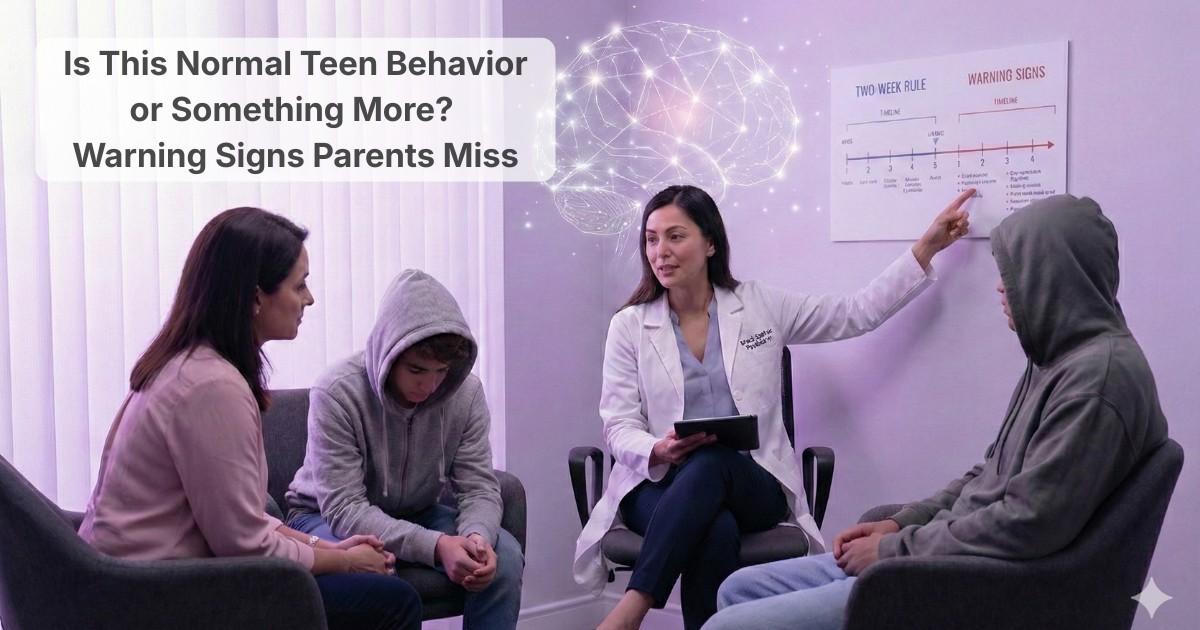
- The Two-Week Rule: When to Start Worrying
- 8 Warning Signs Parents Most Often Miss
- How Depression Looks Different in Boys vs Girls
- When Your Teen Is in Immediate Danger
- What to Do When You Spot the Signs
- Why Parents Miss Depression (and How to Do Better)
- What People Are Asking?
⚡ Key Takeaways
- 18% of adolescents experience major depression, up from 12% a decade ago. For teenage girls, the rate is 25%, more than double the rate for boys at 11%
- The two-week threshold is critical. If sadness or withdrawal persists most of the day for two consecutive weeks and interferes with daily functioning, it’s time to seek professional evaluation
- 40% of parents can’t distinguish between normal mood swings and depression, while 30% say their teen is good at hiding feelings, making early detection challenging
- Depression in teens looks different than in adults. Watch for irritability and anger rather than just sadness, declining grades, social withdrawal from peers (not just parents), and physical symptoms like headaches or stomachaches
- 80% of teens with depression improve with proper treatment, but 60% never receive any help at all, making early recognition and intervention crucial
Look, nobody wants to believe their kid might be depressed. I’ve sat across from hundreds of parents who tell me some version of the same thing: “I thought she was just being a difficult teenager.” Or “He’s always been moody, so I didn’t think anything was wrong.”
The reality is that adolescence is confusing for everyone involved. Your teenager’s brain is undergoing massive changes. Their prefrontal cortex, the part that regulates emotions and makes decisions, won’t finish developing until their mid-twenties. Hormones are surging. They’re trying to figure out who they are while dealing with academic pressure, social media comparison, and a world that often feels overwhelming.
Some irritability, some door-slamming, some “I hate you” moments? Those are par for the course. But there’s a line where typical teenage drama crosses into something more serious. And if you’re reading this, you’re probably wondering whether your teen has crossed that line. Learn more about Dr. Erkut’s approach to adolescent psychiatry.
What is Adolescent Depression?
Adolescent depression is a persistent mood disorder characterized by prolonged feelings of sadness, hopelessness, or irritability that significantly interfere with a teenager’s daily functioning. Unlike typical teenage moodiness, which is temporary and situation-specific, clinical depression lasts for weeks or months and affects multiple areas of life including school performance, relationships, self-care, and physical health.
In teenagers, depression often presents differently than in adults. The hallmark symptom may be irritability and anger rather than visible sadness. A depressed adolescent might appear chronically hostile, easily frustrated, or emotionally volatile rather than tearful or withdrawn.
The key biological mechanism involves disrupted neurotransmitter function, particularly serotonin, dopamine, and norepinephrine. During adolescence, the brain is undergoing significant structural changes, particularly in the prefrontal cortex and limbic system, which regulate emotional processing and impulse control. This developmental vulnerability, combined with genetic predisposition, stressful life events, and environmental factors, can trigger depressive episodes.
Depression in teenagers is not a character flaw, a phase they’ll outgrow, or a sign of weakness. It’s a legitimate medical condition that responds to evidence-based treatment. Without intervention, adolescent depression can persist into adulthood, increasing the risk of substance abuse, academic failure, relationship problems, and suicide.
What “Normal” Teen Behavior Actually Looks Like
Before we talk about warning signs, let’s establish what falls within the normal range of adolescent moodiness. This matters because you can’t identify what’s concerning if you don’t know what’s typical.
Normal Teenage Moodiness Includes:
Mood swings that are situational. Your teen gets upset about a specific thing (a bad grade, an argument with a friend, not making the team) and bounces back within a few days. The mood follows a clear trigger and resolves relatively quickly.
Preferring friends over family. This is developmentally appropriate. Teenagers are supposed to start separating from parents and orienting toward peer relationships. If your teen wants to hang out with friends instead of you, that’s normal. If they’re avoiding friends and isolating from everyone, that’s a red flag.
Sleeping late on weekends. Adolescent circadian rhythms shift later. Teenagers naturally want to stay up later and sleep in later. Sleeping until 10 or 11 on Saturday isn’t concerning. Sleeping 14 hours a day every day, or being unable to get out of bed for school, is concerning.
Testing boundaries and arguing. Pushing back against rules is how teenagers develop independence. Some conflict with parents is expected. What’s not normal is extreme defiance, complete withdrawal, or explosive anger that seems out of proportion to the situation.
Academic fluctuations. Grades might dip during the transition to middle school or high school as the workload increases. A lower grade in one class isn’t alarming. A sudden, dramatic drop across all subjects, or giving up entirely on schoolwork, is alarming.
The Statistics Every Parent Should Know
Let me give you the numbers that should make every parent pay attention. These aren’t meant to scare you. They’re meant to emphasize why early recognition matters.
| Statistic | What It Means |
|---|---|
| 18% of adolescents experience major depression | That’s roughly 1 in 5 teens. In any typical high school classroom, 5 students are struggling |
| 25% of teenage girls have depression | More than double the rate for boys (11%) |
| 50% increase since 2012 | Depression rates have risen from 12% to 18% in just over a decade |
| 60% receive no treatment | Despite being treatable, most depressed teens never get help |
| 40% of high school students feel persistently sad | Nearly half report ongoing sadness or hopelessness over the past year |
| 20% seriously considered suicide | 1 in 5 high school students had suicidal thoughts in 2023 |
These numbers aren’t abstract. They represent actual teenagers sitting in classrooms, going through motions, suffering in ways their parents might not recognize. Depression is the third leading cause of death among 15 to 29-year-olds globally, and the consequences of missing it extend far beyond adolescence.
Early depression predicts lower educational achievement, relationship difficulties, higher rates of substance abuse, and chronic health problems throughout life. But here’s the important part: early treatment changes these outcomes. Teens who get effective treatment develop coping skills that serve them for years.
The Two-Week Rule: When to Start Worrying
The most important threshold to remember is two weeks. This is the clinical cutoff that distinguishes transient sadness from potential depression.
If your teen exhibits concerning behaviors or moods for most of the day, nearly every day, for two consecutive weeks or longer, and these changes interfere with their ability to function, you need to seek professional evaluation.
What “Interfering with Function” Means:
We’re not talking about your teen being a little less enthusiastic than usual. Functional impairment means they’re struggling to do things they need to do or used to do without difficulty:
Problems in multiple life domains. They’re having trouble at school AND with friends AND at home, not just one area. Missing school regularly or refusing to go. Grades dropping significantly across multiple subjects. Withdrawing from friends, activities, and social events they previously enjoyed. Unable to complete basic self-care tasks (showering, getting dressed, eating regularly). Expressing feelings of hopelessness or worthlessness.
“My 16 year old daughter has been really moody for the past month. She stays in her room all the time and barely talks to us anymore. But she’s always been dramatic and I don’t want to overreact. How do I know if I should be worried or if this is just normal teenage stuff?”
A month is beyond the two-week threshold, so yes, I’d recommend getting her evaluated. The key question is this: Is she still connecting with friends, or has she withdrawn from them too? Teens naturally pull away from parents, but if she’s isolated from everyone and this has lasted a month, that’s concerning. I’d start with her pediatrician for a depression screening. Better to check and find out everything’s fine than to wait and wish you’d acted sooner.
8 Warning Signs Parents Most Often Miss
These are the signals that parents frequently overlook or misinterpret. Pay attention to changes from your teen’s baseline, not whether they match some textbook description.
1. Irritability and Anger (Not Just Sadness)
Here’s what catches parents off guard: depressed teenagers often don’t look sad. They look angry. They’re snippy, hostile, easily frustrated. Everything seems to set them off.
Parents mistake this for typical teenage attitude when it’s actually a symptom of depression. If your teen has gone from generally pleasant to chronically irritable for weeks, take note.
2. Physical Complaints Without Medical Cause
Recurring headaches. Frequent stomachaches. Always feeling tired. Your teen visits the school nurse regularly but medical tests come back normal.
Depression often manifests physically in adolescents. They’re not making it up. Their brain’s emotional distress is creating real physical symptoms.
3. Academic Decline That Feels Different
We’re not talking about struggling with calculus or getting a C in a hard class. This is a teen who used to care about school suddenly not turning in any homework. A straight-A student whose grades plummet across all subjects. A kid who loved learning now saying “What’s the point?”
Depression impairs concentration, motivation, and energy levels. When your teen tells you they can’t focus or doesn’t see the point of trying, believe them.
4. Changes in Sleep That Are Extreme
Yes, teenagers need more sleep than adults. But there’s a difference between sleeping until 11 on weekends and sleeping 14 hours a day, every day. Or being unable to fall asleep until 3 or 4 AM despite being exhausted.
Both excessive sleep (hypersomnia) and severe insomnia are warning signs. If your teen’s sleep patterns have dramatically shifted and persisted for weeks, pay attention.
5. Withdrawal From Friends, Not Just Family
This is the distinction that matters. Teenagers pulling away from parents? Normal. Teenagers canceling plans with their closest friends, avoiding social events they used to enjoy, and spending most of their time alone? Not normal.
If your teen has essentially disappeared from their social circle and shows no interest in reconnecting, that’s concerning.
6. Loss of Interest in Everything
The technical term is anhedonia: inability to feel pleasure. Your teen quit the sport they loved. Stopped playing their instrument. Shows no interest in hobbies, activities, or anything that used to bring them joy.
This isn’t finding new interests or changing focus. This is giving up on everything without replacing it with anything else.
“My son quit soccer after playing for 8 years. He loved it, was really good at it, and now he says he doesn’t care anymore. His coach has called asking what happened and my son just shrugs and says he’s not interested. Should I be worried or is he just burned out and needs a break?”
Burnout from a single activity is possible, but if he’s not replacing soccer with anything else he enjoys, I’d be concerned. The question to ask is whether he still has things in his life that bring him joy and energy. If the answer is no, and this has been going on for more than a couple weeks, it’s worth having him evaluated for depression. Loss of interest in previously enjoyed activities is one of the hallmark symptoms.
7. Negative Self-Talk That’s Persistent
Teenagers can be self-critical. But there’s a difference between “I’m so stupid, I failed that test” after an actual bad grade and persistent, global statements like “I’m worthless,” “I can’t do anything right,” or “Everyone would be better off without me.”
Pay attention to language that suggests hopelessness, worthlessness, or self-hatred. These aren’t normal teenage insecurities.
8. Risky or Reckless Behavior
Depression doesn’t always look like withdrawal. Some teenagers act out. Reckless driving. Substance use. Sexual promiscuity. Getting into fights. Engaging in dangerous behaviors without apparent concern for consequences.
This can be a way of expressing emotional pain or trying to feel something when depression has numbed everything else.
How Depression Looks Different in Boys vs Girls
The statistics show a dramatic gender difference: 25% of teenage girls experience depression compared to 11% of boys. But it’s not just about rates. Depression also manifests differently by gender.
Depression in Teenage Girls Often Looks Like:
Persistent sadness and tearfulness. Excessive worry and anxiety (often co-occurring with depression). Social withdrawal and isolation. Changes in eating patterns (either significantly more or less). Physical complaints like headaches and stomachaches. Perfectionism and self-criticism. Self-harm behaviors (cutting, burning). Expressed feelings of worthlessness.
Depression in Teenage Boys Often Looks Like:
Irritability and anger rather than sadness. Aggression and hostility. Defiant or oppositional behavior. Increased risk-taking. Substance use. Physical symptoms (but less likely to report them). Withdrawal that looks like “not caring” about anything. Less likely to seek help or acknowledge feelings.
Boys are socialized to hide vulnerability, so they often mask sadness with anger or indifference. This means parents and teachers more frequently misinterpret depression in boys as behavioral problems rather than recognizing it as a mental health issue.
When Your Teen Is in Immediate Danger
Some situations require immediate intervention, not scheduling an appointment next week. These are signs of acute risk:
Talking about suicide or death. Comments like “I wish I was dead,” “You’d be better off without me,” “I want to disappear,” or “I don’t want to be here anymore” should always be taken seriously. Don’t assume they’re being dramatic.
Giving away possessions. Suddenly giving away important items, organizing belongings “for when I’m gone,” or making unusual arrangements.
Saying goodbye. Unusual goodbyes to friends or family members that feel final. Expressing that they won’t be around much longer.
Researching methods. Looking up suicide methods online, acquiring means (stockpiling pills, accessing weapons), or discussing specific plans.
Sudden calmness after deep depression. A teen who’s been severely depressed suddenly seems peaceful or resolved. This can indicate they’ve made a decision to act on suicidal thoughts.
One in five high school students seriously considered suicide in 2023. Suicide is the third leading cause of death among 15 to 29-year-olds. These aren’t abstract statistics. They’re preventable tragedies that happen when warning signs are missed or dismissed.
“My daughter made a comment yesterday about how everyone would be happier if she wasn’t around. She said it casually while we were in the car. Do I bring this up and risk making her more upset or am I overthinking a throwaway comment? I don’t want to plant ideas in her head if she wasn’t serious.”
You need to address this directly. Research shows that asking about suicide does not plant ideas. What it does is give teenagers permission to talk about feelings they’re already having. Have a calm, caring conversation. Tell her you heard what she said and you’re worried. Ask if she’s been having thoughts about hurting herself. If she says yes, get immediate help. If she says no but has been feeling hopeless, get her evaluated by a professional this week. Don’t wait.
What to Do When You Spot the Signs
You’ve identified concerning symptoms. What now? Here’s the step-by-step approach I recommend to parents.
Step 1: Start With an Open, Non-Judgmental Conversation
Pick a calm moment. Not when you’re both stressed or in the middle of an argument. Tell your teen what specific behaviors you’ve noticed and why they worry you.
Instead of “What’s wrong with you?” try: “I’ve noticed you’ve been staying in your room a lot lately and you haven’t been hanging out with your friends. I’m worried about you. Can we talk about how you’ve been feeling?”
Listen without interrupting. Don’t minimize their feelings. Don’t immediately jump to solutions. Just listen.
Step 2: Schedule an Appointment With Their Pediatrician
The American Academy of Pediatrics recommends depression screening for all adolescents starting at age 12. Your teen’s pediatrician can do this screening as part of a regular checkup.
This is often less intimidating than jumping straight to a psychiatrist, and it rules out medical causes for symptoms (thyroid problems, anemia, vitamin deficiencies can all mimic depression).
Step 3: Get a Specialized Mental Health Evaluation
If screening suggests depression, the next step is a comprehensive psychiatric evaluation by a board-certified child and adolescent psychiatrist or licensed therapist who specializes in teenagers.
This evaluation assesses the severity of symptoms, identifies any co-occurring conditions (anxiety, ADHD, substance use), and develops a treatment plan tailored to your teen’s specific needs.
Step 4: Consider Evidence-Based Treatment Options
Treatment for teen depression typically involves some combination of:
Psychotherapy: Cognitive-behavioral therapy (CBT), interpersonal therapy (IPT), and dialectical behavior therapy (DBT) all have strong evidence for treating adolescent depression. Many teens benefit from therapy alone without medication.
Medication: For moderate to severe depression, or when therapy alone isn’t sufficient, antidepressant medication can be effective. The decision about medication should be made collaboratively between you, your teen, and a board-certified child and adolescent psychiatrist who can carefully monitor for side effects.
Family involvement: Family dynamics often play a role in both the development and treatment of teen depression. Family therapy or parent coaching can improve outcomes significantly.
Why Parents Miss Depression (and How to Do Better)
According to a national poll, two-thirds of parents cite barriers in recognizing youth depression. Here’s what gets in the way and how to overcome these obstacles.
Barrier 1: Difficulty Distinguishing Normal from Concerning
40% of parents struggle to differentiate between typical mood swings and signs of depression. The solution? Use the two-week rule. If concerning behaviors persist most of the day, nearly every day, for two weeks or longer, seek evaluation. When in doubt, check it out. A false alarm is better than missing real depression.
Barrier 2: Teens Hide Their Feelings
30% of parents say their teen is good at hiding feelings. Teenagers are private by nature and often minimize symptoms when asked directly. This is why you need to pay attention to behavioral changes, not just what your teen tells you. Actions speak louder than words.
Barrier 3: Parental Overconfidence
A third of parents believe nothing would interfere with their ability to recognize depression in their child. This overconfidence can be dangerous. Some parents may be overestimating their ability to read their teen’s emotional state.
The parent-child dynamic shifts dramatically during adolescence. You might not know your teenager as well as you think you do. Stay humble and stay vigilant.
Barrier 4: Normalizing Everything as “Just a Phase”
Parents desperately want things to be okay. It’s easier to believe your teen is “going through a phase” than to confront the possibility of mental illness. But dismissing warning signs doesn’t make them go away. It just delays treatment.
Barrier 5: Stigma and Shame
Some parents worry that acknowledging their teen’s depression reflects poorly on their parenting. This is nonsense. Depression is a medical condition influenced by genetics, brain chemistry, environmental stressors, and developmental factors. It’s not your fault, and getting help is a sign of strength, not weakness.
What people are asking?
Concerned About Your Teen? Get a Professional Evaluation
Dr. Erkut specializes in adolescent psychiatry and provides comprehensive evaluations to determine whether your teen’s behavior is typical adolescent development or requires clinical intervention. Early assessment can make all the difference.
SCHEDULE AN ADOLESCENT EVALUATION
Sources & References
- Centers for Disease Control and Prevention. (2023). Youth Risk Behavior Survey (YRBS) Data Summary & Trends Report.
- National Institute of Mental Health. (2025). Major Depression Among Adolescents.
- Brody DJ, Hughes JP. (2025). Depression Prevalence in People Age 12 and Older: United States, August 2021–August 2023. NCHS Data Brief No. 527.
- World Health Organization. (2025). Mental health of adolescents. Fact Sheet.
- American Academy of Pediatrics. (2025). Mental Health and Teens: Watch for Danger Signs.
- University of Michigan C.S. Mott Children’s Hospital. National Poll on Children’s Health: Parents Cite Barriers in Recognizing Youth Depression.
- American Psychiatric Association. (2013). Diagnostic and Statistical Manual of Mental Disorders (5th ed.).
This content is for informational purposes only and does not constitute medical advice. Individual teen mental health presentations vary significantly based on developmental factors, family history, and environmental circumstances. Always consult with a qualified healthcare provider, preferably a board-certified child and adolescent psychiatrist, to assess your teen’s specific situation. Dr. Erkut provides comprehensive evaluations for families concerned about adolescent mental health.